Pytania i odpowiedzi (1 / 5)
Windows Serwer 2012 R2 70-411
Your network contains an Active Directory forest named contoso.com. All domain controllers run Windows Server 2008 R2.
The schema is upgraded to Windows Server 2012 R2.
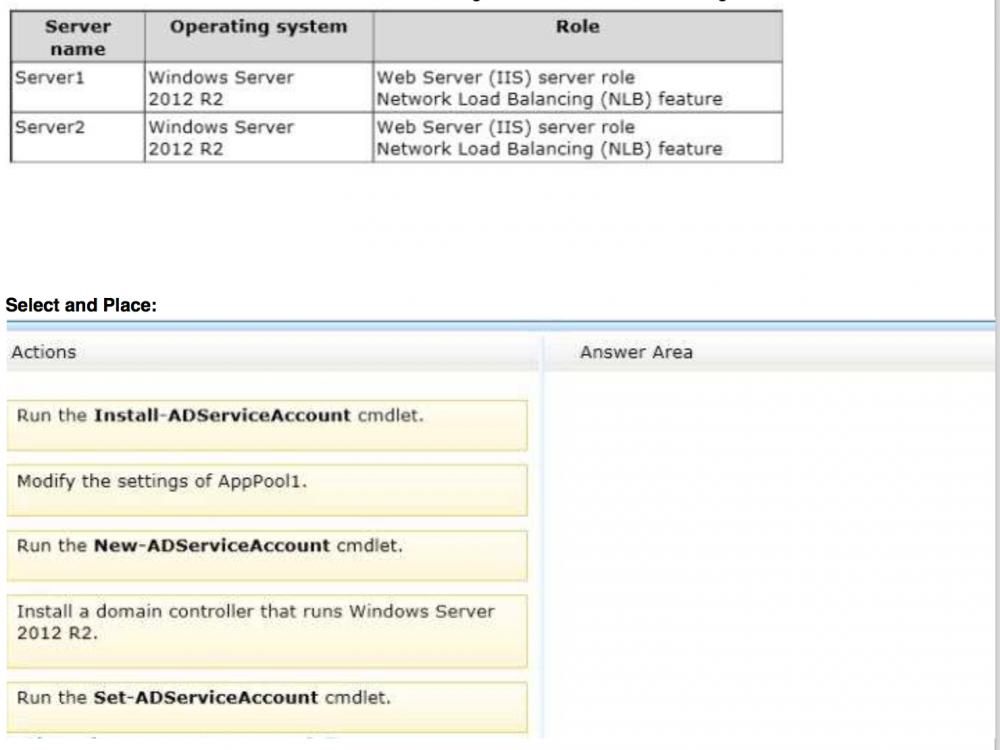
Contoso.com contains two servers. The servers are configured as shown in the following table.
Server1 and Server2 host a load-balanced application pool named AppPool1.
You need to ensure that AppPool1 uses a group Managed Service Account as its identity.
Which three actions should you perform?
To answer, move the three appropriate actions from the list of actions to the answer area and arrange them in the correct order.
1.
1
Install a domain controller that runs Windows Server 2012 R2
2.
2
Run the New-ADServiceAccount cmdlet
3.
3
Modify the settings of Apppool1
4.
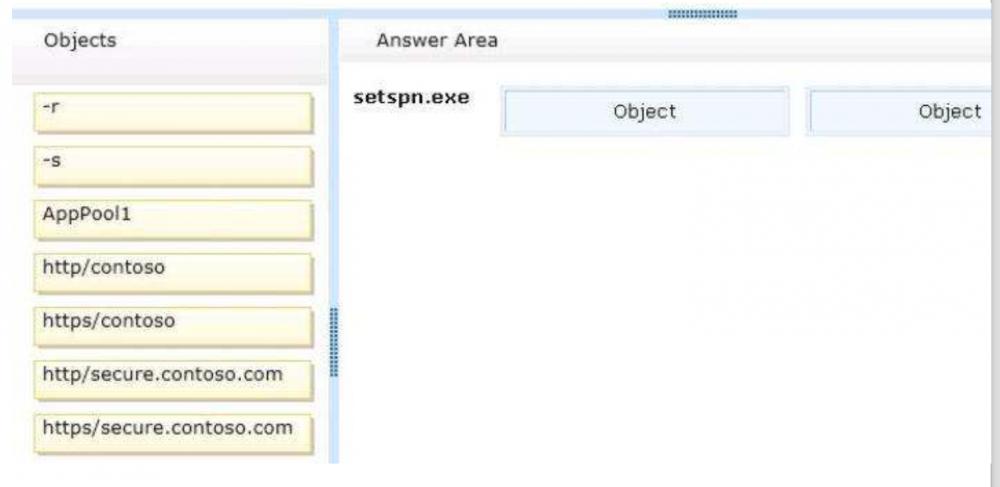
-s, https/secure.contoso.com, AppPool1
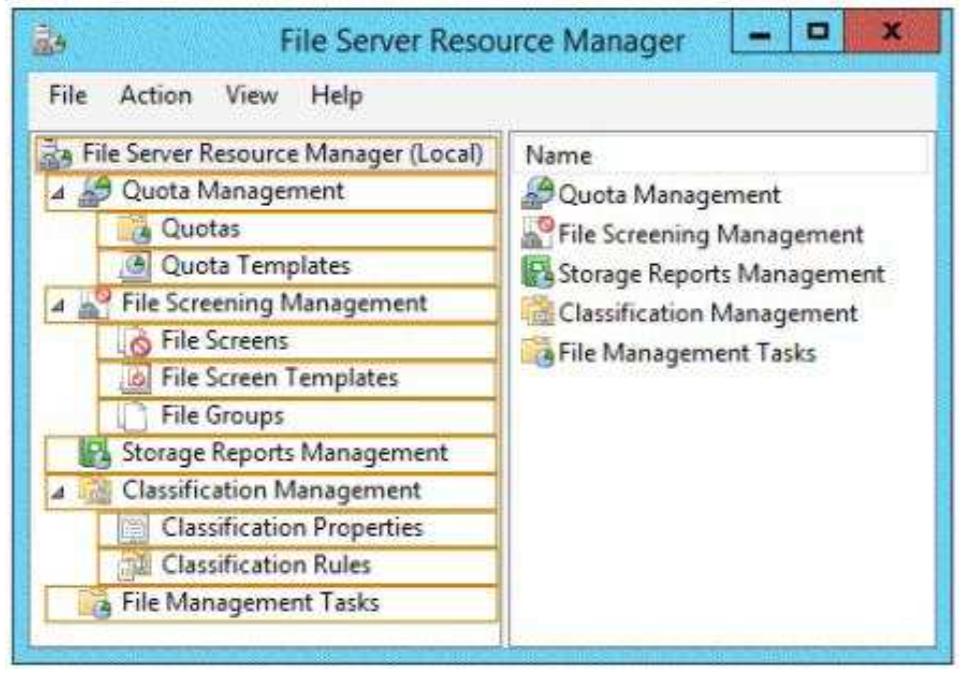
Your network contains an Active Directory domain named contoso.com. The domain contains a server named Server1 that runs Windows Server 2012 R2. Server1 has the File Server Resource Manager role service installed.
You need to configure Server1 to meet the following requirements:
■ Ensure that old fiies in a folder named Foider1 are archived automaticaiiy to a folder named Archive1.
■ Ensure that all storage reports are saved to a network share.
Which two nodes should you configure?
To answer, select the appropriate two nodes in the answer area.
Wpisz 1-13
5.
1
1
6.
2
13
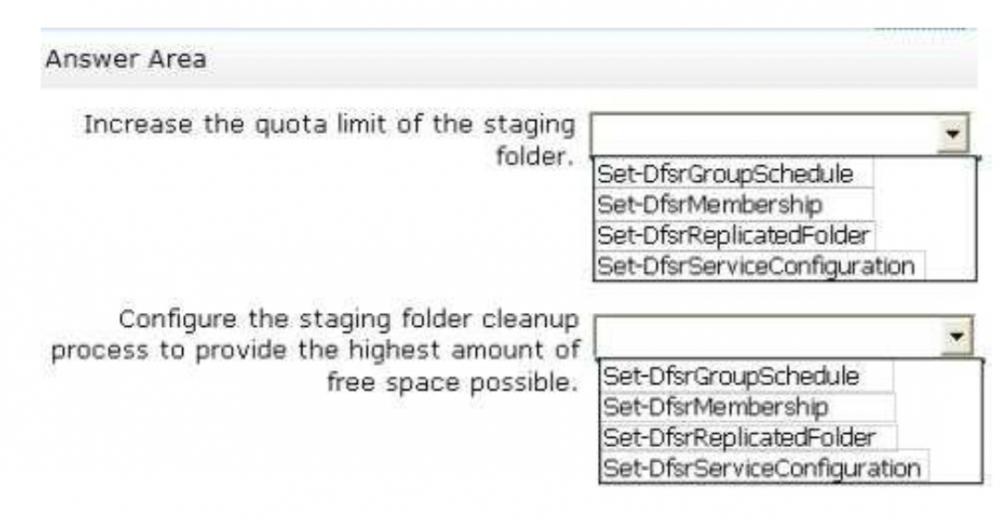
Your network contains an Active Directory domain named contoso.com. The domain contains servers named Server1 and Server2. Both servers have the DFS Replication role service installed.
You need to configure the DFS Replication environment to meet the following requirements:
Increase the quota limit ot the staging folder.
■ Configure the staging folder cleanup process to provide the highest amount ot free space possible.
Which cmdlets should you use to meet each requirement?
To answer, select the appropriate options in the answer area.
Wpisz 1-4
7.
Increase the quota limit…
2
8.
Configure the staging folder...
4
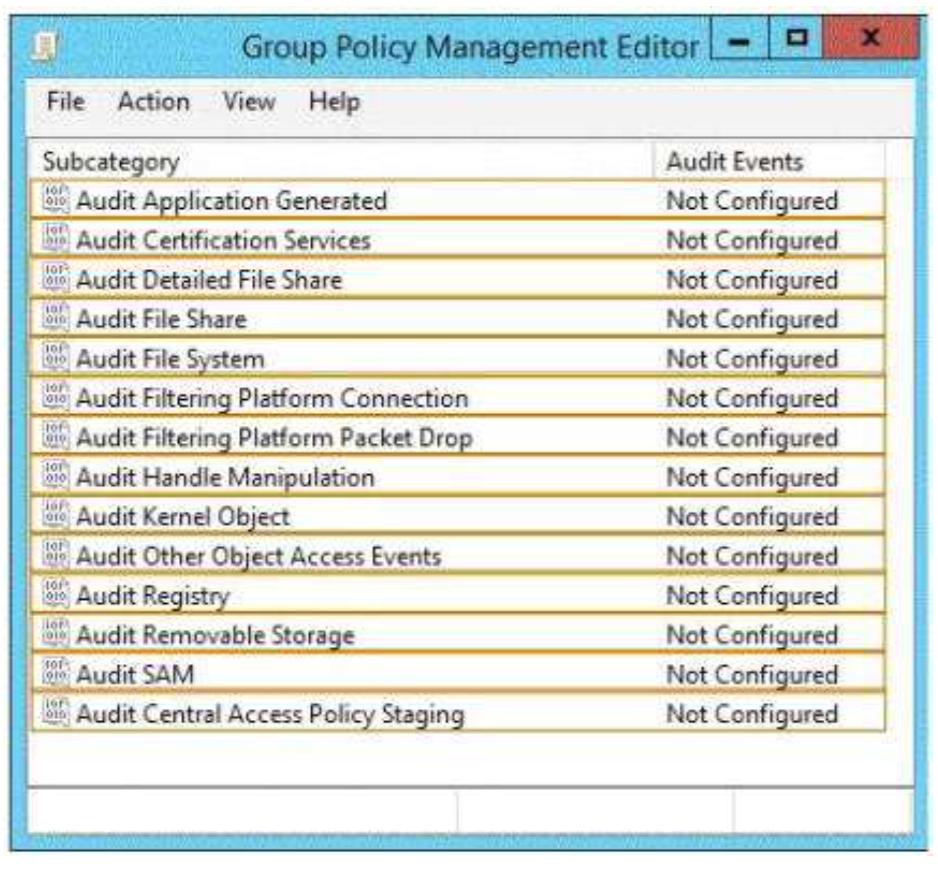
Your network contains an Active Directory domain named contoso.com. All servers run Windows Server 2012 R2.
You need to audit successful and failed attempts to read data from USB drives on the servers.
Which two objects should you configure?
To answer, select the appropriate two objects in the answer area.
9.
1
Audit Handle Manipulation
10.
2
Audit Removable Storage
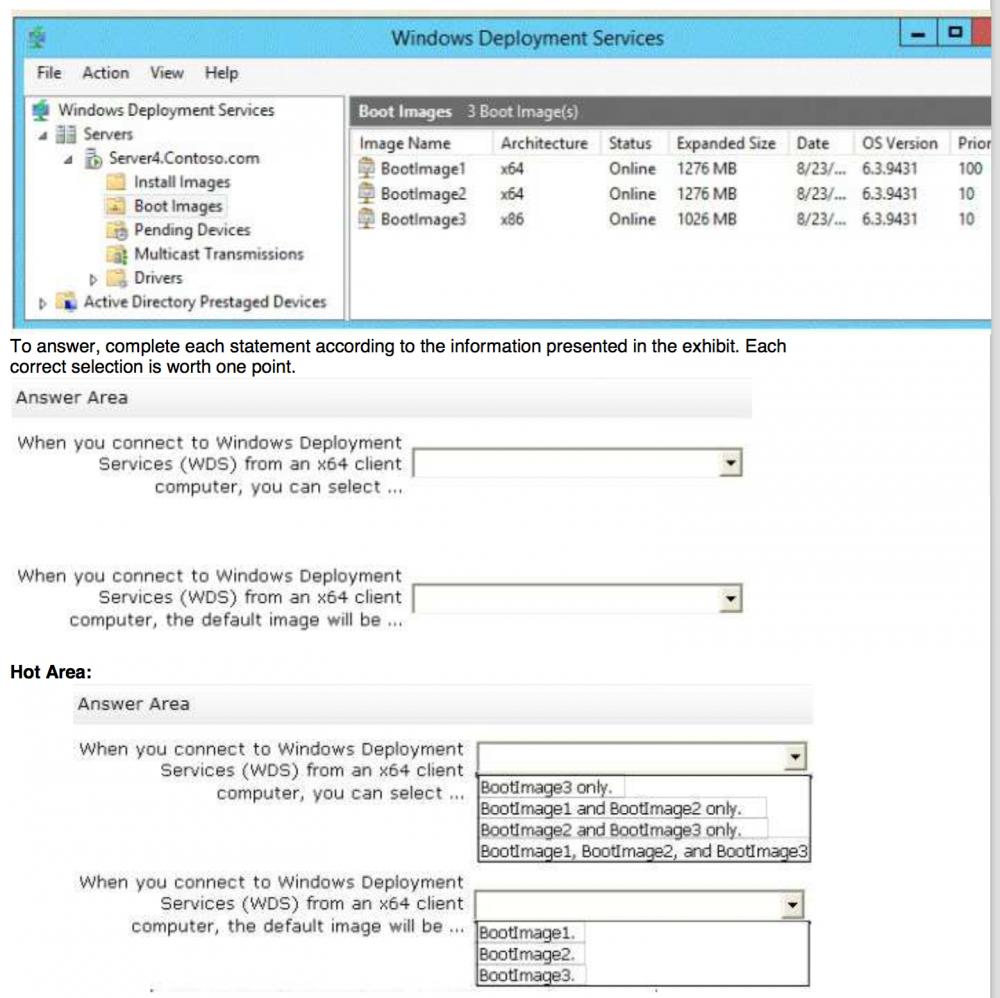
You have a server named Server4 that runs Windows Server 2012 R2. Server4 has the Windows
Deployment Services server role installed.
Server4 is configured as shown in the exhibit. (Click the Exhibit button.)
To answer, complete each statement according to the information presented in the exhibit. Each
correct selection is worth one point.
11.
Combo Box 1
BoorImage1, BootImage2, and BootImage3
12.
Combo Box 2
BootImage2
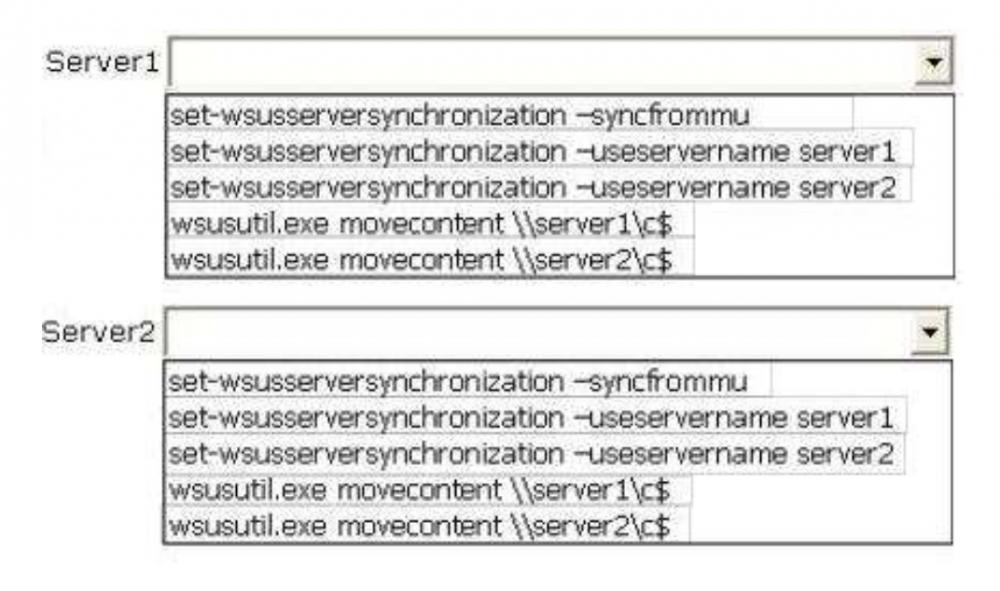
Your network contains an Active Directory domain named contoso.com.
The domain contains three member servers named Server1, Server2, and Server3. All servers run Windows Server
2012 R2 and have the Windows Server Update Services (WSUS) server role installed.
Server1 and Server2 are configured as replica servers that use Server3 as an upstream server.
You remove Servers from the network.
You need to ensure that WSUS on Server2 retrieves updates from Server1.
The solution must ensure that Server1 and Server2 have the latest updates from Microsoft.
Which command should you run on each server? To answer, select the appropriate command to run on each server in the answer area.
13.
Server1
1
14.
Serwer2
2
15.
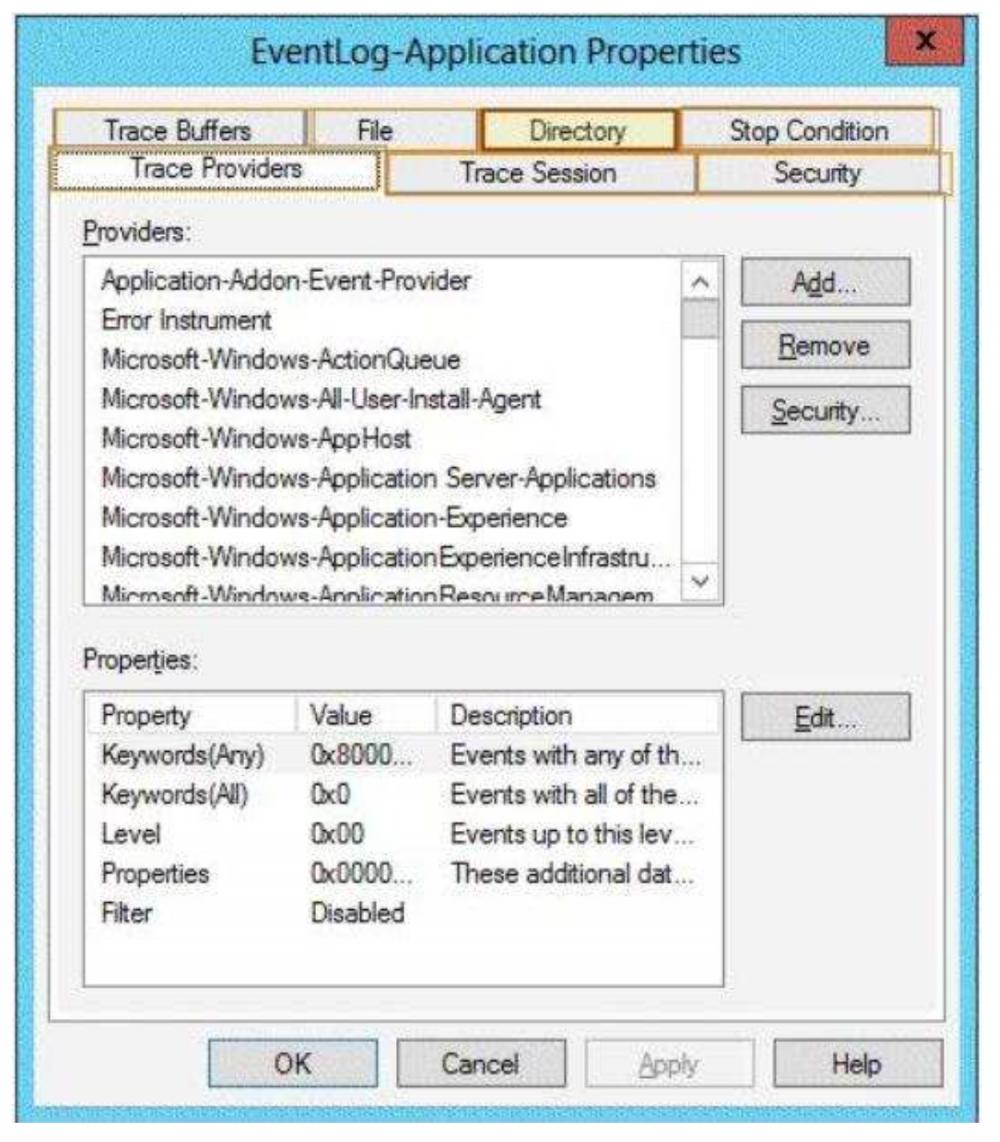
Stop Condition
16.
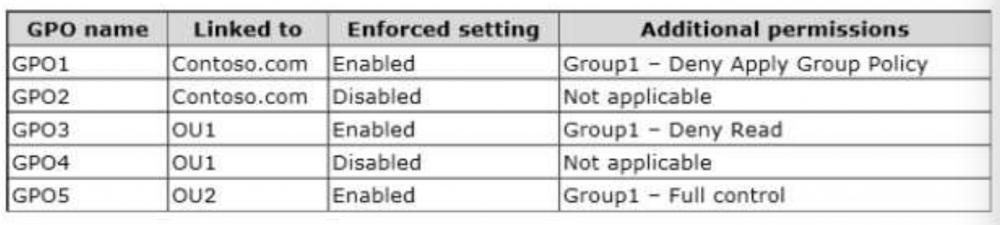
Run startup scripts asynchronously
17.
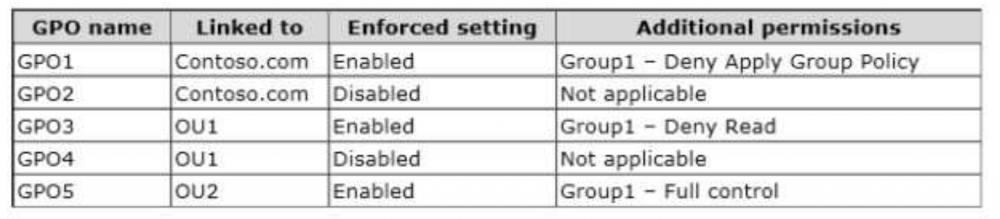
GPO5, GPO2, GPO4
18.
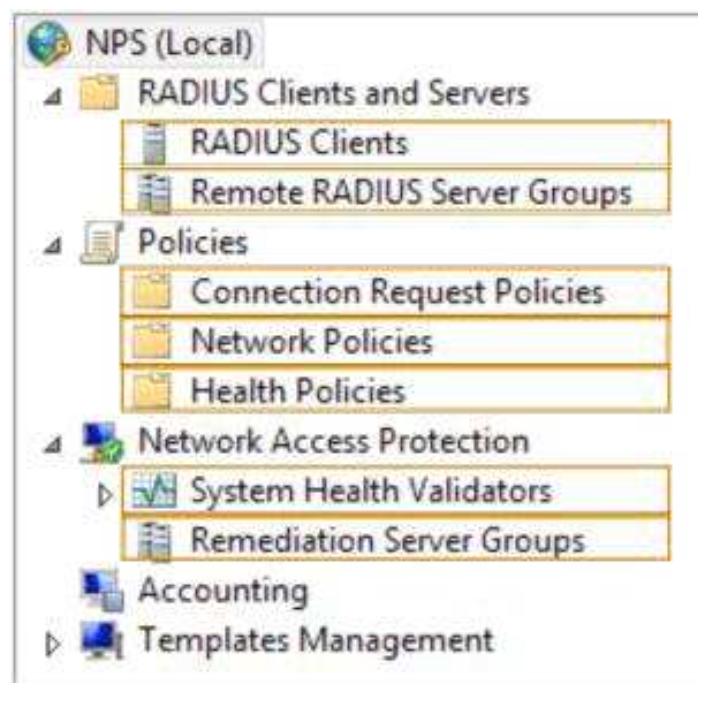
Remote RADIUS Server Groups
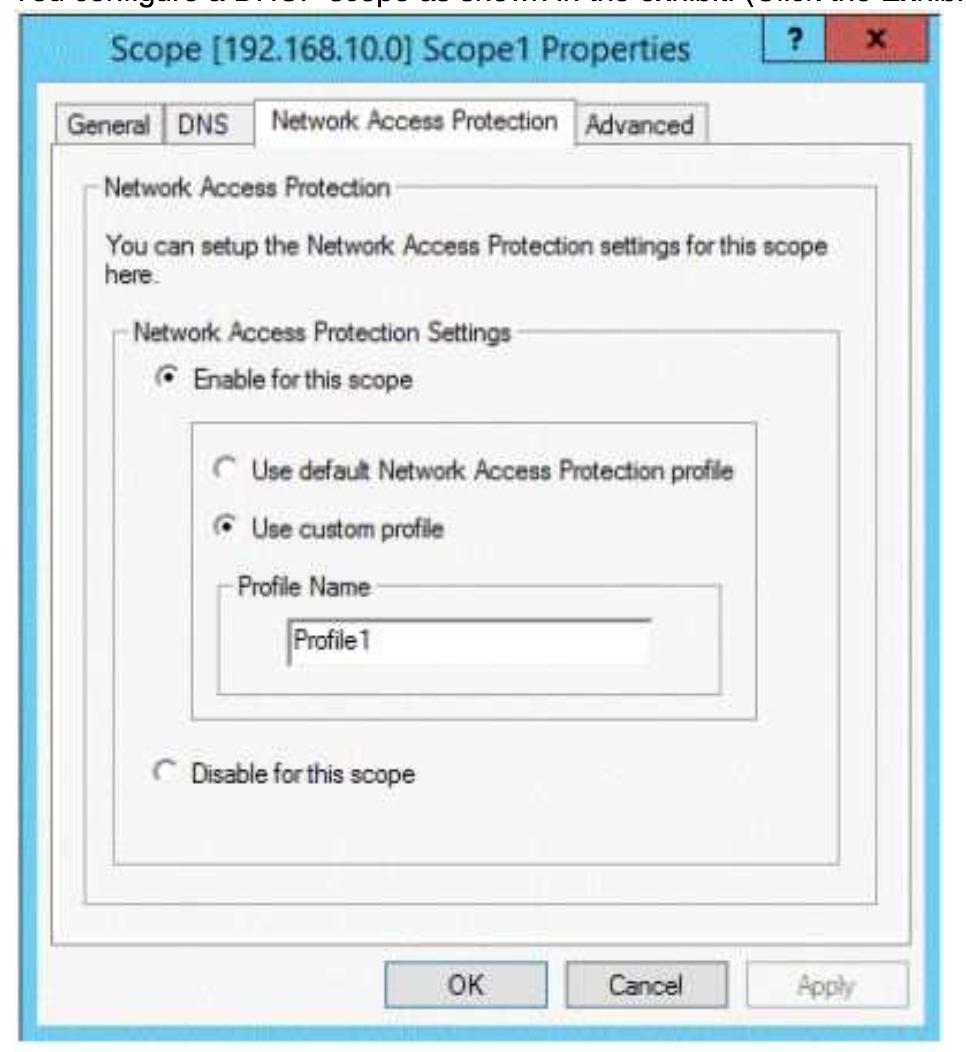
Your network contains an Active Directory domain named contoso.com. The domain contains
two servers named Server1 and Server2.
Server1 has the Network Policy Server server role
installed. Server2 has the DHCP Server server role installed. Both servers run Windows Server
2012 R2.
You are configuring Network Access Protection (NAP) to use DHCP enforcement.
You configure a DHCP scope as shown in the exhibit. (Click the Exhibit button.)
You need to ensure that non-compliant NAP clients receive different DHCP options than
compliant NAP clients.
What should you configure on each server?
To answer, select the appropriate options for each server in the answer area
19.
Server1
Health Polices
20.
Server2
Server options
21.
a policy
22.
Identity-Type
23.
a User class
24.
a Vendor class
25.
filters
26.
Ms-Service class
27.
Service-Type
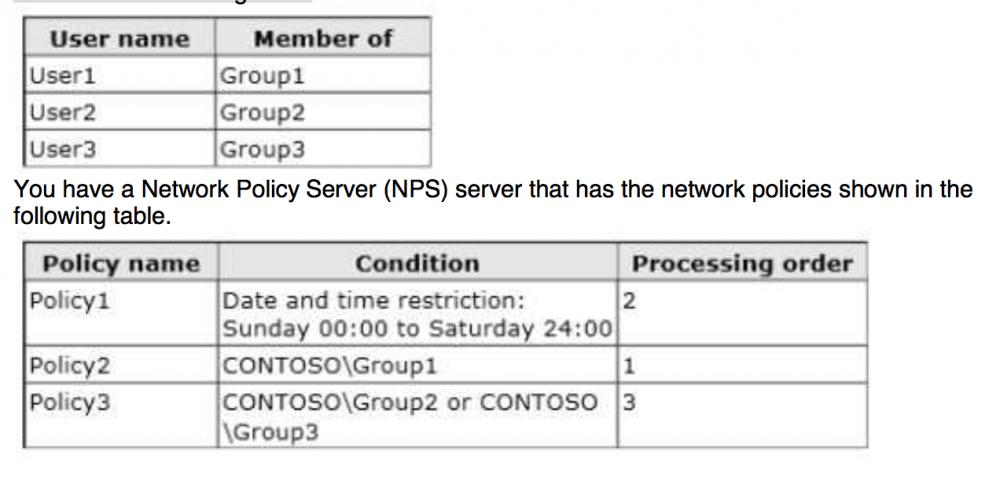
Your network contains an Active Directory domain named contoso.com. The domain contains the users shown in the following table.
User1, User2, and User3 plan to connect to the network by using a VPN. You need to identify which network policy will apply to each user.
What should you identify?
To answer, select the appropriate policy for each user in the answer area
Wpisz 1-3
28.
User1
2
29.
User2
1
30.
User3
1
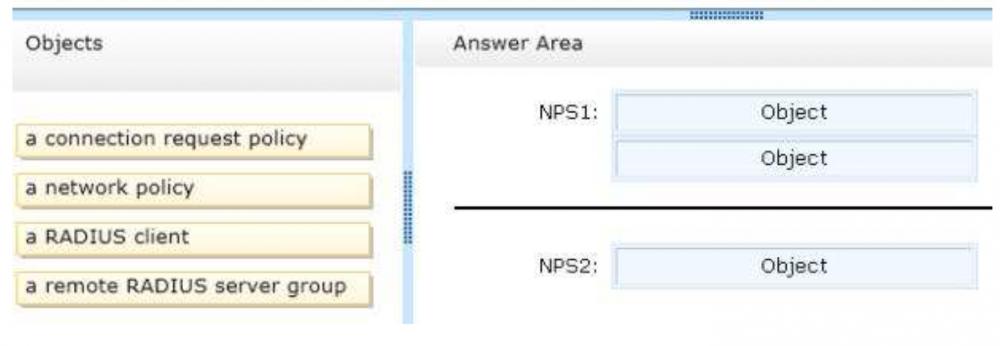
Your network contains an Active Directory forest named contoso.com. The forest contains a Network Policy
Server (NPS) server named NPS1 and a VPN server named VPN1. VPN1 forwards all authentication
requests to NPS1.
A partner company has an Active Directory forest named adatum.com. The adatum.com forest contains an
NPS server named NPS2.
You plan to grant users from adatum.com VPN access to your network.
You need to authenticate the users from adatum.com on VPN1.
What should you create on each NPS server?
To answer, drag the appropriate objects to the correct NPS servers. Each object may be used once, more than once, or not at all. You may need to drag the split bar between panes or scroll to view content.
Select and Place:
31.
NPS1
a connection request policy
32.
NPS1
a remote RADIUS server group
33.
NPS2
a RADIUS client
34.
Nie potrzebne
a network policy
35.
Your network contains an Active Directory forest named contoso.com. The forest functional level is Windows Server 2012 R2. The forest contains a single domain.
You create a Password Settings object (PSO) named PSO1.
You need to delegate the rights to apply PSO1 to the Active Directory objects in an organizational unit named OU1.
What should you do?
From Active Directory Administrative Center, modify the security settings of PSO1
36.
Configure a Service Principal Name (SPN) for User1
37.
Your network contains an Active Directory domain named contoso.com. The domain contains an
organizational unit (OU) named IT and an OU named Sales.
All of the help desk user accounts are located in the IT OU.
All of the sales user accounts are located in the
Sales OU. The Sales OU contains a global security group named G_Sales. The IT OU contains a global
security group named G_HelpDesk.
You need to ensure that members ot GJHelpDesk can perform the following tasks:
■ Reset the passwords ot the sales users.
■ Force the sales users to change their password at their next logon.
What should you do?
Right-click the Sales OU and select Delegate Control
38.
Your company deploys a new Active Directory forest named contoso.com. The first domain controller in the
forest runs Windows Server 2012 R2. The forest contains a domain controller named DC10.
On DC10, the disk that contains the SYSVOL folder fails.
You replace the failed disk. You stop the Distributed File System (DFS) Replication service.
You restore the SYSVOL folder.
You need to perform a non-authoritative synchronization of SYSVOL on DC 10.
Which tool should you use before you start the DFS Replication service on DC10?
Adsiedit.msc
39.
Your network contains an Active Directory domain named contoso.com. Domain controllers run either
Windows Server 2003, Windows Server 2008 R2, or Windows Server 2012 R2.
A support technician accidentally deletes a user account named User1.
You need to use tombstone reanimation to restore the User1 account.
Which tool should you use?
Ldp
40.
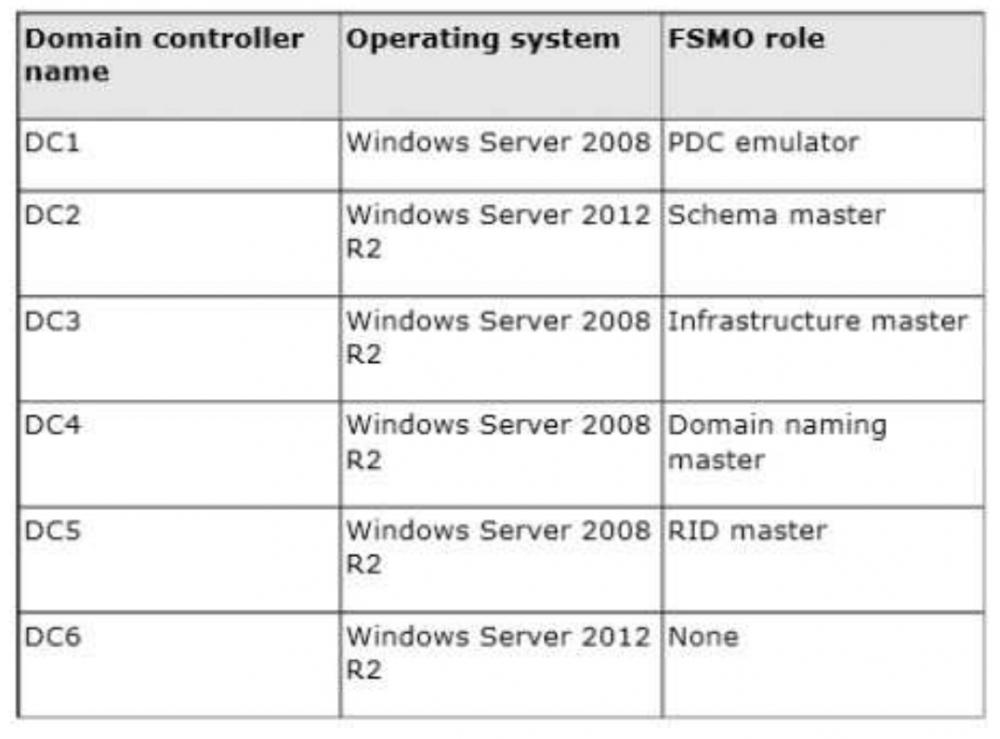
Transfer the PDC emulator to DC2
41.
Your network contains an Active Directory domain named contoso.com. All servers run Windows Server 2012 R2.
An organizational unit (OU) named ResearchServers contains the computer accounts of all research
servers.
Ali domain users are configured to have a minimum password length of eight characters.
You need to ensure that the minimum password length of the local user accounts on the research servers
in the ResearchServers OU is 10 characters.
What should you do?
Create and link a Group Policy object (GPO) to the ResearchServers OU
42.
You have a server named Server1 that runs Windows Server 2012 R2. Server1 has the Windows
Deployment Services server role installed.
Server1 contains two boot images and four install images.
You need to ensure that when a computer starts from PXE, the available operating system images appear
in a specific order.
What should you do?
Modify the properties ot the install images
43.
Your network contains a domain controller named DC1 that runs Windows Server 2012 R2. You create a custom Data Collector Set (DCS) named DCS1.
You need to configure DCS1 to collect the following information:
■ The amount ot Active Directory data replicated between DC1 and the other domain controllers
■ The current values ot several registry settings
Which two should you configure in DCS1 ? (Each correct answer presents part ot the solution.
Choose two.)
A Performance Counter Alert, System configuration information
44.
You have a server that runs Windows Server 2012 R2.
You have an offline image named Windows2012.vhd that confains an insfallafion of Windows Server 2012 R2.
You plan to apply several updates to Windows2012.vhd.
You need to mount Windows2012.vhd to D:\Mount.
Which tool should you use?
Dism
45.
You have a server named Server1 that runs Windows Server 2012 R2.
You need to configure Server1 to create an entry in an event log when the processor usage exceeds 60
percent.
Which type ot data collector should you create?
A performance counter alert
46.
Your network contains three Network Policy Server (NPS) servers named NPS1, NPS2, and NPS3.
NPS1 is configured as a RADIUS proxy that forwards connection requests to a remote RADIUS server
group named Group1.
You need to ensure that NPS2 receives connection requests. NPS3 must oniy receive connection requests
if NPS2 is unavailable.
How should you configure Group1 ?
Change the Priority of NPS3 to 10
47.
Your network contains an Active Directorydomain named contoso.com. Network Access Protection (NAP)
is deployed to the domain.
You need to create NAP event trace log files on a client computer.
What should you run?
logman
48.
Your network contains an Active Directory domain named contoso.com. All domain controllers run
Windows Server 2012 R2.
You create a central store for Group Policy.
You receive a custom administrative template named Templatel .admx.
You need to ensure that the settings in Templatel .admx appear in all new Group Policy objects (GPOs).
What should you do?
Copy Templatel .admx to \\Contoso.com\SYSVOL\Contoso.com\Policies\PolicyDefinitions\
49.
Your network contains an Active Directory domain named contoso.com. All domain controllers run Windows Server 2012 R2.
A domain controller named DO has the ADMX Migrator tool installed. You have a custom Administrative
Template file on DC1 named Templatel.adm.
You need to add a custom registry entry to Templatel .adm by using the ADMX Migrator tool.
Which action should you run first?
Generate ADMX from ADM
50.
Your network contains an Active Directory domain named contoso.com. All domain controllers run Windows Server 2012 R2.
An organizational unit (OU) named OU1 contains 200 client computers that run Windows 8 Enterprise. A
Group Policy object (GPO) named GP01 is linked to OU1.
You make a change to GP01.
You need to force all of the computers in OU1 to refresh their Group Policy settings immediately.
The solution must minimize administrative effort.
Which tool should you use?
Group Policy Management Console (GPMC)
51.
our network contains two servers named Server1 and Server2. Both servers run Windows Server 2012
R2 and have the DNS Server server role installed. Server1 hosts a primary zone for contoso.com. Server2
hosts a secondary zone for contoso.com. The zone is not configured to notify secondary servers of
changes automatically.
You update several records on Server1.
You need to force the replication of the contoso.com zone records from Server1 to Server2.
What should you do from Server2?
Right-click the contoso.com zone and click Transfer from Master
52.
Your network contains two servers named Served and Server2 and have the DNS Server server role installed.
Both servers run Windows Server 2012 R2
On Server1, you create a standard primary zone named contoso.com.
You plan to create a standard primary zone for ad.contoso.com on Server2. You need to ensure that
Server1 forwards all gueries for ad.contoso.com to Server2.
What should you do from Server1 ?
Create a zone delegation that points to Server2
53.
You have a DNS server named Server1.
Server1 has a primary zone named contoso.com.
Zone Aging/Scavenging is configured for the contoso.com zone.
One month ago, an administrator removed a server named Server2 from the network.
You discover that a static resource record for Server2 is present in contoso.com. Resource records for
decommissioned client computers are removed automatically from contoso.com.
You need to ensure that the static resource records for all ot the servers are removed automatically from contoso.com.
What should you modify?
The Record time stamp value ot the static resource records
54.
Your network contains an Active Directory domain named contoso.com. The domain contains a server
named Server1 that runs Windows Server 2012 R2.
You enable and configure Routing and Remote Access (RRAS) on Server1.
You create a user account named User1.
You need to ensure that User1 can establish VPN connections to Server1.
What should you do?
Create a network policy
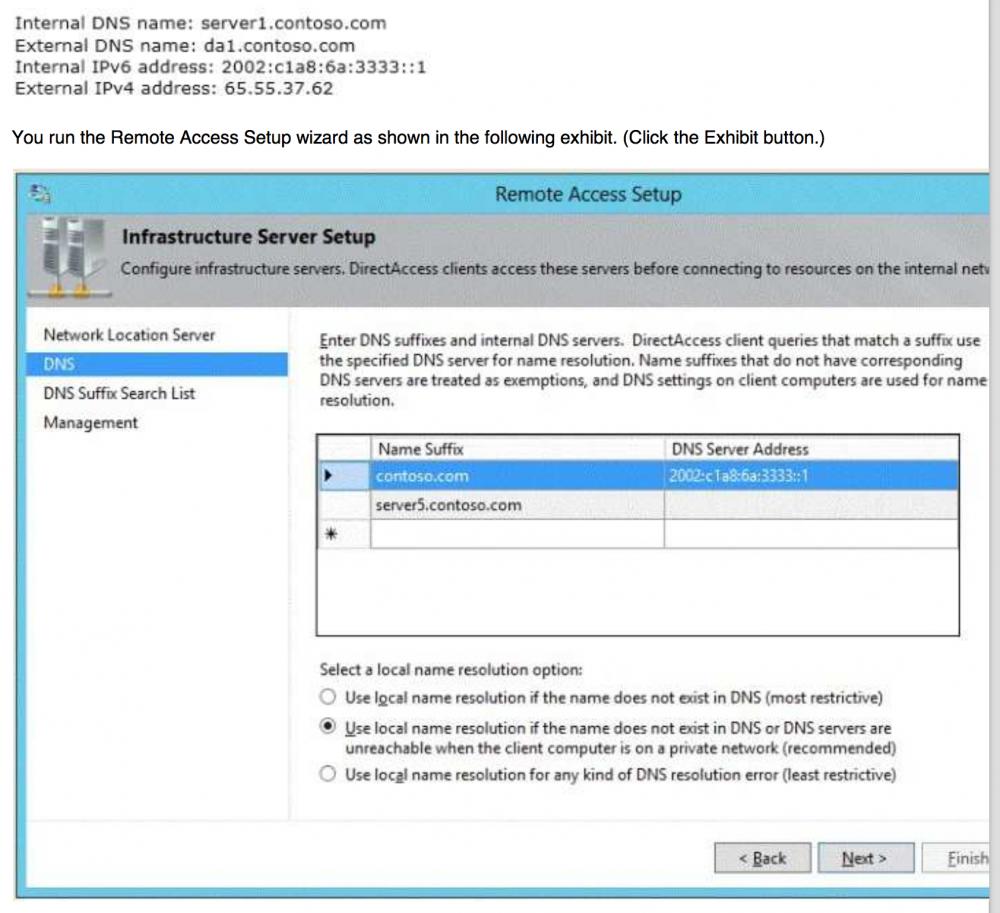
55.
A Name Suffix value of dal.contoso.com and a blank DNS Server Address value
56.
Your network contains an Active Directory domain named contoso.com. The domain contains a server named Server1 that runs Windows Server 2012 R2.
Server1 has the following role services installed: DirectAccess and VPN (RRAS)
Network Policy Server
Remote users have client computers that run either Windows XP, Windows 7, or Windows 8.
You need to ensure that only the client computers that run Windows 7 or Windows 8 can establish VPN connections to Server1.
What should you configure on Server1?
A condition of a Network Policy Server (NPS) network policy
57.
You are a network administrator of an Active Directory domain named contoso.com.
You have a server named Server1 that runs Windows Server 2012 R2. Server1 has the DHCP Server server role and the Network Policy Server role service installed.
You enable Network Access Protection (NAP) on all of the DHCP scopes on Server1.
You need to create a DHCP policy that will apply to all of the NAP non-compliant DHCP clients. Which criteria should you specify when you create the DHCP policy?
The user class
58.
Your network contains an Active Directory domain named contoso.com. The domain contains a server named Server1 that runs Windows Server 2012 R2 and has the Network Policy Server role service installed.
An administrator creates a RADIUS client template named Template1. You create a RADIUS client named Client1 by using Template 1.
You need to modify the shared secret for Client1. What should you do first?
Clear Select an existing template for Client1
59.
Your network contains an Active Directory domain named contoso.com. All servers run Windows Server 2012 R2.
The domain contains a server named Server1 that has the Network Policy Server server role and the Remote Access server role installed. The domain contains a server named Server2 that is configured as a RADIUS server.
Server1 provides VPN access to external users.
You need to ensure that all of the VPN connections to Server1 are logged to the RADIUS server on Server2.
What should you run?
Add-RemoteAccessRadius -ServerName Server2 -AccountingOnOffMsg Enabled -SharedSecret "Secret" -Purpose Accounting
60.
Your network contains four Network Policy Server (NPS) servers named Server1, Server2, Server3, and Server4.
Server1 is configured as a RADIUS proxy that forwards connection requests to a remote RADIUS server group named Group1.
You need to ensure that Server2 and Server3 receive connection requests. Server4 must only receive connection requests if both Server2 and Server3 are unavailable.
How should you configure Group1?
Change the Priority of Server4 to 10
61.
Your network contains an Active Directory domain named adatum.com. A network administrator creates a Group Policy central store.
After the central store is created, you discover that when you create new Group Policy objects (GPOs), the GPOs do not contain any Administrative Templates.
You need to ensure that the Administrative Templates appear in new GPOs.
What should you do?
Copy files from %Windir%\Policydefimtions to the central store
62.
Your network contains an Active Directory domain named contoso.com. All domain controllers run
Windows Server 2012 R2. The domain contains 500 client computers that run Windows 8 Enterprise. You implement a Group Policy central store.
You have an application named App1. App1 requires that a custom registry setting be deployed to all of the computers.
You need to deploy the custom registry setting. The solution must minimize administrator effort. What should you configure in a Group Policy object (GPO)?
The Group Policy preferences
63.
Your network contains two Active Directory forests named contoso.com and dev.contoso.com. The contoso.com forest contains a domain controller named DC1. The dev.contoso.com forest contains a domain controller named DC2. Each domain contains an organizational unit (OU) named OU1.
Dev.contoso.com has a Group Policy object (GPO) named GPO1. GPO1 contains 200 settings, including several settings that have network paths. GPO1 is linked to OU1.
You need to copy GPO1 from dev.contoso.com to contoso.com. What should you do first on DC2?
Run the Backup-Gpo cmdlet
64.
Your network contains an Active Directory domain named contoso.com. All servers run Windows Server 2012 R2.
Client computers run either Windows 7 or Windows 8. All of the client computers have an application named App1 installed.

The domain contains a Group Policy object (GPO) named GPO1 that is applied to all of the client computers.
You need to add a system variable named App1Data to all of the client computers. Which Group Policy preference should you configure?
Environment
65.
Your network contains an Active Directory domain named contoso.com.
All user accounts reside in an organizational unit (OU) named OU1.
You create a Group Policy object (GPO) named GPO1. You link GPO1 to OU1. You configure the Group Policy preference of GPO1 to add a shortcut named Link1 to the desktop of each user. You discover that when a user deletes Link1, the shortcut is removed permanently from the desktop.
You need to ensure that if a user deletes Link1, the shortcut is added to the desktop again. What should you do?
Modify the Link1 shortcut preference of GPO1
66.
You manage a server that runs Windows Server 2012 R2. The server has the Windows Deployment Services server role installed.
You have a desktop computer that has the following configuration: Computer name: Computer1
Operating system: Windows 8
MAC address: 20-CF-30-65-D0-87
GUID: 979708BF-C04B-4525-9FE0-C4150BB6C618
You need to configure a pre-staged device for Computer1 in the Windows Deployment Services console.
Which two values should you assign to the device ID? (Each correct answer presents a complete solution. Choose two.)
979708BF-C04B-452S-9FE0-C4150BB6C618, 0000000000000000000020CF306SD087
67.
You have Windows Server 2012 R2 installation media that contains a file named Install.wim. You need to identify the permissions of the mounted images in Install.wim
Run dism.exe and specify the /get-mountedwiminfo parameter
68.
You have a server named Server1 that runs Windows Server 2012 R2. You create a Data Collector Set (DCS) named DCS1.
You need to configure DCS1 to log data to D:\logs. What should you do?
Right-click DCS1 and click Properties
69.
Your network contains an Active Directory domain named adatum.com. The domain contains a member server named Server1 and 10 web servers. All of the web servers are in an organizational unit (OU) named WebServers_OU. All of the servers run Windows Server 2012 R2.
On Server1, you need to collect the error events from all of the web servers. The solution must ensure that when new web servers are added to WebServers_OU, their error events are collected automatically on
Server1.
What should you do?
On Server1, create a source computer initiated subscription. From a Group Policy object (GPO), configure the Configure target Subscription Manager setting
70.
Your network contains a Hyper-V host named Hyperv1. Hyperv1 runs Windows Server 2012 R2.
Hyperv1 hosts four virtual machines named VM1, VM2, VM3, and VM4. All ot the virtual machines run
Windows Server 2008 R2.
You need to view the amount ot memory resources and processor resources that VM4 currently uses.
Which tool should you use on Hyperv1 ?
Hyper-V Manager